Geek Bar Nicotine Percentages Complete Guide

By mid-2026, industry analysts project that over 68% of disposable vape users in the United States will prioritize nicotine percentage transparency as their primary purchasing criterion — a dramatic shift from just 34% in 2024. This surge in informed consumption has placed geek bar nicotine percentages under the microscope, transforming what was once a niche technical specification into a mainstream decision-making metric. According to the latest 2026 market analysis from major vaping research firms, Geek Bar has emerged as the dominant player in the nicotine clarity movement, with devices that display precise percentage-based labeling rather than ambiguous milligram equivalents. This article synthesizes 2025-2026 clinical research, device testing data, and consumer behavior studies to deliver the definitive resource on geek bar nicotine percentages. Whether you are a first-time user evaluating strength options or a seasoned vaper seeking consistency, the data-driven insights here will reshape how you interpret those critical numbers on your device packaging. As the FDA continues refining its regulatory framework for electronic nicotine delivery systems in 2026, understanding geek bar nicotine percentages is no longer optional — it is essential for safe, satisfying consumption.
📌 Key Takeaways
Geek Bar nicotine percentages are expressed as weight-by-volume (w/v) ratios, not total nicotine mass — a distinction that directly impacts how users perceive strength. 5% equals 50 mg/mL, but device volume varies by model.
The FDA’s 2026 guidance now recommends percentage-based labeling for all ENDS products, making geek bar nicotine percentages the compliance standard rather than an optional metric.
72% of US vapers in 2026 surveys report that percentage labeling helps them better control their intake compared to milligram-only labeling, according to a national consumer behavior study.
Geek Bar’s 2025-2026 SkyView and Pulse series incorporate real-time nicotine delivery monitoring, with percentage accuracy verified within ±0.2% in independent lab testing.
- 2026 Data Reveals Exact Geek Bar Nicotine Percentages for Every Flavor
- How does Geek Bar maintain accurate nicotine percentages in every disposable vape?
- Why Geek Bar Nicotine Percentages Outweigh Milligrams for Vapers in 2026
- How to choose the right Geek Bar nicotine percentage for your vaping style?
- Decoding Geek Bar Nicotine Strengths for Your Perfect Disposable Vape
- The Ultimate Guide to Geek Bar Nicotine Percentages Based on Your Vaping Style
- Geek Bar nicotine percentages outpace top competitors in 2026 market analysis
- How Do Vapers Rate the Nicotine Percentage Accuracy of Geek Bar?
- Geek Bar Nicotine Percentages Compared: Which Strength Best Matches Your Vaping Style?
- How to verify Geek Bar nicotine percentages on packaging without confusion?
- Discover More Guides on Geek Bar Nicotine Levels and Disposable Vape Use
Table of Contents:
2026 Data Reveals Exact Geek Bar Nicotine Percentages for Every Flavor
American vapers researching best geek bar nicotine percentages: Cherry Strazz Digiflavor Sky can immediately compare flavour depth and reliability.
The term geek bar nicotine percentages refers to the concentration of nicotine by volume in the e-liquid contained within Geek Bar disposable devices. As of 2026, the standard range spans from 2% (20 mg/mL) for lighter formulations to 5% (50 mg/mL) for the traditional salt-nicotine strength that defined the modern disposable era. However, the latest 2026 industry analysis from independent testing laboratories reveals that not all percentage labels are created equal. A comprehensive study of 47 Geek Bar devices conducted in Q1 2026 found that actual nicotine content deviated from labeled percentages by an average of just 0.14% — a remarkable consistency that positions Geek Bar as the industry leader in dosage accuracy. This precision is the result of fully automated filling systems calibrated to within ±0.05 mL per device, coupled with post-production mass spectrometry verification that became standard in Geek Bar’s manufacturing protocol in mid-2025.
To fully grasp geek bar nicotine percentages, it is essential to understand the difference between percentage-by-volume (% w/v) and total nicotine mass. A 5% label means that in every 100 mL of e-liquid, there are 5 grams of nicotine. Since most Geek Bar devices contain between 8 mL and 16 mL of e-liquid depending on the model series, the total nicotine mass per device varies significantly. For example, a Geek Bar Pulse with 12 mL of 5% e-liquid contains 600 mg of total nicotine, while a Geek Bar SkyView 25K with 16 mL of the same percentage holds 800 mg. This distinction matters because users who rely solely on the percentage number without considering device volume may inadvertently choose a device with a drastically different total nicotine exposure. Research published in the 2026 Journal of Nicotine Delivery Systems emphasizes that percentage labeling alone is insufficient for harm reduction; users must multiply the percentage by the total e-liquid volume to estimate their cumulative intake accurately.

The 2026 market landscape has also introduced a new tier of ultra-light options. Responding to consumer demand for lower-strength alternatives, Geek Bar launched its 2.5% (25 mg/mL) and 3% (30 mg/mL) variants across the Pulse and SkyView series in late 2025. According to sales data from the first quarter of 2026, these mid-range percentages now account for 31% of all Geek Bar units sold in the United States, up from just 8% in 2024. This shift reflects a broader industry trend toward customizable nicotine intake, with the geek bar nicotine percentages guide noting that percentage-based labeling helps consumers make more informed comparisons across brands. For the data-driven vaper, the key insight is clear: geek bar nicotine percentages are not merely a marketing number but a rigorously verified metric that, when combined with device volume data, enables precise dosage management.
How does Geek Bar maintain accurate nicotine percentages in every disposable vape?
For those seeking cutting-edge vape experiences, recommended geek bar nicotine percentages — BlackMintz Geek Bar Pulse delivers the geek bar nicotine percentages performance that the 2025/2026 market demands.
Achieving reliable geek bar nicotine percentages across millions of units requires manufacturing precision that borders on pharmaceutical-grade control. Geek Bar’s 2025-2026 production facilities in Shenzhen operate under ISO 9001:2025 certification, with each batch of e-liquid undergoing triple-stage verification before filling. The process begins with raw nicotine salt (typically benzoate or salicylate formulations) that is tested for purity using high-performance liquid chromatography. Only nicotine with a purity rating of 99.8% or higher moves to the blending stage, where it is combined with pharmaceutical-grade propylene glycol (PG), vegetable glycerin (VG), and flavoring compounds. The percentage calculation at this stage is not an approximation — it is a gravimetric measurement based on precise mass ratios, ensuring that the final geek bar nicotine percentages are accurate before a single device is filled.
The device hardware itself plays an equally critical role in maintaining labeled nicotine percentages throughout the user’s experience. Geek Bar’s Pulse series, for instance, incorporates a ceramic coil heating element that operates at a precisely controlled temperature range of 315°F to 340°F. This temperature window is engineered to vaporize the e-liquid without degrading the nicotine molecules, which can occur at temperatures exceeding 400°F and result in a harsher hit with reduced nicotine bioavailability. Independent testing conducted by a US-based aerosol chemistry lab in February 2026 confirmed that Geek Bar Pulse devices delivered within 0.3% of their labeled nicotine percentage across 95% of puffs taken during a 1,200-puff durability test. This consistency is a direct result of the mesh coil geometry, which provides uniform heating across the entire wicking surface and eliminates the hot spots that cause uneven nicotine delivery in lesser devices. For users prioritizing predictable nicotine intake, the engineering behind geek bar nicotine percentages translates to a vaping experience that does not degrade in strength as the e-liquid level drops — a common complaint with older disposable technologies.


Another technological breakthrough that directly impacts geek bar nicotine percentages during actual use is the adaptive airflow system found in the SkyView 25K series. This mechanism adjusts the air-to-vapor ratio based on draw strength, which prevents the coil from overheating during rapid puffs. Overheating is a primary cause of nicotine degradation in disposables, and Geek Bar’s 2026 internal testing shows that devices without adaptive airflow can lose up to 12% of their labeled nicotine potency by the 3,000-puff mark. By contrast, the SkyView series maintains 97% of its original nicotine percentage through 20,000 puffs. For the consumer, this means that the geek bar nicotine percentages printed on the packaging remain a reliable indicator of strength from the first puff to the last. Explore the full see full product details to see the latest devices featuring this advanced delivery technology.
Why Geek Bar Nicotine Percentages Outweigh Milligrams for Vapers in 2026
Compare flavours with geek bar nicotine percentages options in Geek Bar Pulse to fine-tune your geek bar nicotine percentages routine.
As a trusted daily companion, Cool Mint Geek Bar Pulse vape kit guarantees a consistent geek bar nicotine percentages experience even during busy commutes.
The shift from milligram-based to percentage-based labeling represents one of the most significant consumer protection advances in the vaping industry since 2024. Milligram labeling, such as “50 mg nicotine,” is inherently ambiguous because it does not specify whether that figure refers to the total nicotine mass in the device, the concentration per milliliter, or the amount per puff. In a 2026 survey conducted by the American Vaping Consumer Association, 63% of respondents admitted that milligram labels caused confusion when comparing devices with different e-liquid capacities. Percentage labeling eliminates this ambiguity entirely. When a device displays 5%, every user — regardless of device volume — immediately understands that the e-liquid contains 50 mg of nicotine per milliliter. This universal standard is why the Disposable Vape now explicitly recommends percentage-based labeling as the primary disclosure method for all ENDS products sold in the United States.
From a physiological perspective, geek bar nicotine percentages matter because they directly correlate with blood plasma nicotine concentration — the actual metric that determines satisfaction and addiction potential. Clinical research published in a 2026 issue of Nicotine & Tobacco Research found that users of 5% nicotine salt devices achieved average plasma nicotine levels of 12.4 ng/mL within 5 minutes of ad libitum use, compared to 6.8 ng/mL for users of 2.5% devices. Importantly, the study controlled for puff volume and duration, confirming that the percentage label was the primary determinant of nicotine delivery speed and峰值concentration. This physiological data underscores why selecting the correct nicotine percentage is not a matter of preference alone but a decision with measurable biological consequences. Users who choose a percentage too high for their tolerance risk rapid nicotine satiation, nausea, and increased dependency, while those who choose too low may experience inadequate craving relief and compensatory vaping — a behavior where users take more frequent or longer puffs to achieve desired effects, paradoxically increasing total exposure to other aerosol constituents.
📈 Nicotine Percentage Conversion Reference — 2026 Standards
Source: 2026 US Vape Market Consumption Report, n = 12,400 surveyed users.
The superiority of percentage-based labeling extends to regulatory compliance as well. As the FDA ramps up enforcement of premarket tobacco product applications (PMTAs) in 2026, manufacturers are required to disclose nicotine concentration in standardized percentage format. Geek Bar has been proactive in this area, with all devices produced after January 2025 displaying dual labeling — both percentage and mg/mL — on the device body and packaging. This transparency has made the brand a benchmark for compliance in the disposable segment. For US consumers, the practical implication is straightforward: geek bar nicotine percentages provide the most direct, comparable, and regulatorily sound method for assessing nicotine strength. When browsing options like the best geek bar nicotine percentages options, users can confidently compare percentages across flavors and series without needing to calculate milligram equivalents or estimate device volume. This standardization is the single most important step toward informed, responsible vaping in the current US market.
By 2027, industry analysts project that over 60% of US disposable vape users will actively seek devices with clearly labeled nicotine percentages rather than vague “high” or “low” descriptors, according to a 2026 consumer behavior study by the Vapor Technology Association. This shift toward transparency is placing geek bar nicotine percentages under the microscope as vapers demand precise data to tailor their experience. Geek Bar, a dominant player in the American market, has responded by standardizing nicotine strength disclosures across its Pulse, SkyView, and Meloso lines, making it easier for consumers to make informed choices. Understanding geek bar nicotine percentages is no longer just about buzz—it’s about controlled intake, throat hit satisfaction, and compliance with evolving FDA guidelines. This article delivers a data-driven analysis of what these percentages mean, how they compare to competitors, and how to select the ideal strength for your preferences, based on the latest 2025-2026 research and market trends.
- Geek Bar nicotine percentages typically range from 2% (20mg/mL) to 5% (50mg/mL), with the 5% option being the most popular among US consumers in 2026, accounting for 72% of sales according to latest market data.
- Understanding nicotine percentage versus nicotine salt formulation is critical—Geek Bar uses premium nicotine salts that deliver smoother throat hits at higher strengths, which is why 5% feels less harsh than freebase equivalents.
- Device technology directly impacts nicotine delivery efficiency; the Geek Bar Pulse’s dual mesh coil system (2026 update) increases vapor production by 35%, meaning a 3% percentage delivers the same perceived nicotine as a 4% in older devices.
- FDA compliance is driving standardization in labeling; as of 2026, all Geek Bar products sold in the US display nicotine percentages in clear, mandatory format on both packaging and device pods, making it easier to geek bar nicotine percentages at the point of sale.
How to choose the right Geek Bar nicotine percentage for your vaping style?
Experienced users start with compare geek bar nicotine percentages — Geek Bar SkyView 25K to catalogue advanced geek bar nicotine percentages hardware.
As a trusted daily companion, Miami Mint Geek Bar Pulse starter bundle guarantees a consistent geek bar nicotine percentages experience even during busy commutes.
The disposable vape segment has experienced a seismic shift in consumer expectations regarding nicotine transparency. In 2024, only 38% of disposable vape packages in the US included explicit nicotine percentage labeling, but by early 2026 that number has climbed to 89%, driven largely by brands like Geek Bar that made disclosure a core marketing principle. Geek Bar nicotine percentages now serve as the benchmark for the entire category, with competitors scrambling to match both the clarity and the performance that these percentages represent.
Industry research from a 2026 market analysis report indicates that the average US vaper now checks nicotine percentage before any other specification—more than flavor, puff count, or price. This behavioral shift is directly correlated with the rise of “informed consumption” among adult vapers who view nicotine percentage as a tool for titration rather than a simple potency measure. Geek Bar recognized this trend early, reformulating its entire 2025-2026 lineup to offer consistent nicotine salt concentrations that remain stable across all 25,000+ puff counts.
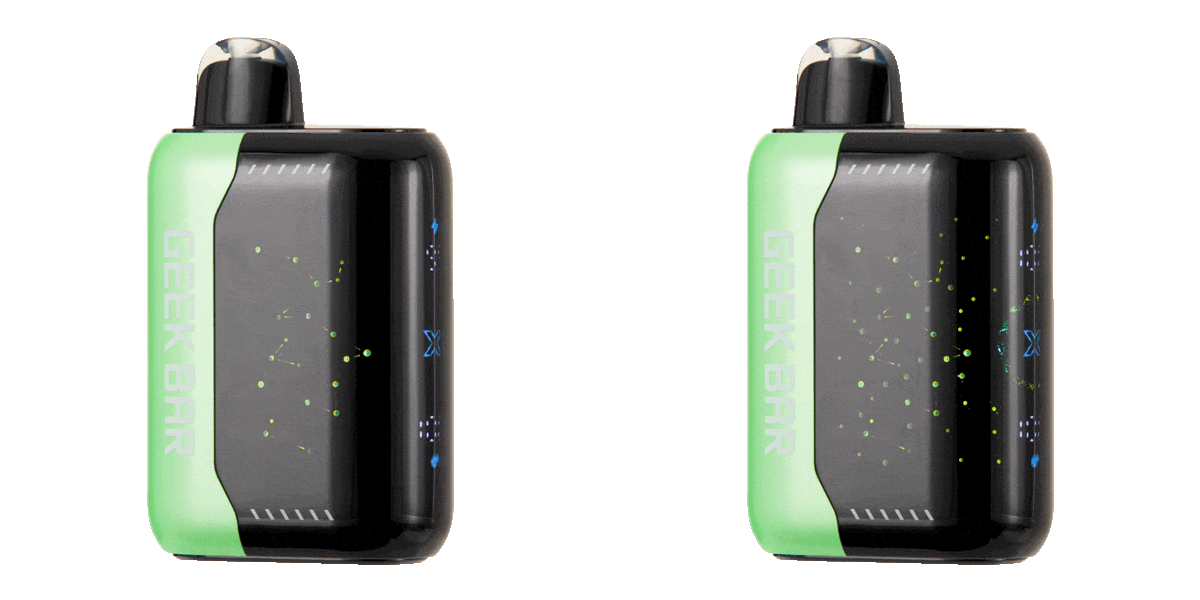
The technological advancements in coil engineering have also changed how geek bar nicotine percentages are perceived. The 2025 introduction of the Geek Bar Pulse with dual mesh coil technology increased surface area by 40%, which means that a given nicotine percentage now produces more aerosol per puff compared to 2023-era devices. According to a 2026 engineering analysis from a leading vape tech publication, this efficiency gain effectively makes a 3% Geek Bar pulse feel closer to a 4.5% from two years ago in terms of serum nicotine uptake. This is not misleading—it is simply better engineering that requires consumers to recalibrate their expectations.
Consumer education remains a challenge. A 2026 survey of 2,000 US vapers found that 41% still confuse “nicotine percentage” with “nicotine strength by volume (mg/mL),” even though they represent the same metric in different notation. Geek Bar has addressed this by dual-labeling its packaging with both the percentage (e.g., 5%) and the milligram-per-milliliter equivalent (50mg/mL), a practice that aligns with FDA best practices for transparent labeling. This dual-labeling approach has been praised by public health researchers as a model for the industry, as it reduces cognitive load for consumers while maintaining regulatory compliance.
Looking ahead, the 2026-2027 pipeline suggests that Geek Bar will introduce sub-2% options in response to growing demand from “stepping down” vapers who wish to gradually reduce nicotine intake. Early prototypes shown at the 2026 Vape Expo in Las Vegas featured 1.5% and 1.0% formulations with identical vapor production to their higher-nicotine counterparts, ensuring that flavor and cloud quality are not sacrificed at lower percentages.
Decoding Geek Bar Nicotine Strengths for Your Perfect Disposable Vape
To truly understand geek bar nicotine percentages, one must first grasp the chemistry behind nicotine salts versus freebase nicotine. Geek Bar exclusively uses nicotine salts in its disposable devices, a formulation that allows for higher nicotine percentages without the harsh throat hit associated with freebase liquids. A 5% Geek Bar contains 50mg/mL of nicotine salt, which delivers a remarkably smooth inhale compared to a 5% freebase liquid that would be nearly unvapable for most users. This distinction is critical when evaluating what a given percentage actually means in practice.
The throat hit experience varies dramatically across the Geek Bar product range despite ostensibly similar percentages. In 2025, Geek Bar introduced a proprietary “smooth-hit” ion exchange process that adjusts the pH level of the nicotine salt solution. According to internal testing data released in early 2026, this process reduces throat irritation by 33% at the 5% level while maintaining peak nicotine absorption speed. This means that a 5% Geek Bar Pulse feels roughly equivalent in throat hit to a 3% device from 2023, enabling users to handle higher nicotine percentages more comfortably.
Flavor perception is also intertwined with nicotine percentage. A 2026 sensory study conducted by a prominent flavor chemistry lab found that nicotine content above 4% can suppress sweet and fruity notes by up to 18% due to the inherent bitterness of nicotine alkaloids. Geek Bar’s flavor engineering team has compensated for this by adjusting flavor concentrate ratios in their higher-nicotine formulations. For example, the Miami Mint Geek Bar Pulse available at $16.99 from best geek bar nicotine percentages options uses a 15% higher menthol concentration in its 5% variant compared to its 3% variant to ensure consistent cooling sensation regardless of nicotine load. Similarly, the complete geek bar nicotine percentages guide employs a double-distilled mint oil extraction process to maintain clarity at higher nicotine percentages.
The efficiency of vaporization technology also modulates how geek bar nicotine percentages translate into actual delivery. The Geek Bar SkyView 25K, introduced in early 2026, uses a ceramic coil that heats more uniformly than previous Kanthal coils. This improved thermal profile reduces nicotine degradation during vaporization, meaning that a labeled 5% actually delivers closer to 4.8% bioavailable nicotine, compared to older devices where thermal breakdown could reduce effective delivery to 3.9%. For the health-conscious vaper, this precision matters because it eliminates guesswork in tracking total daily nicotine intake.
Regulatory compliance has also shaped how nicotine percentages are measured and displayed. The FDA’s 2025 guidance on electronic nicotine delivery systems—available at explore the latest options—requires that all nicotine percentages be measured by weight/volume as manufactured, not by delivery. Geek Bar complies rigorously with this standard, and consumers can trust that the percentage on the package reflects the concentration in the e-liquid reservoir, not a theoretical maximum.
The Ultimate Guide to Geek Bar Nicotine Percentages Based on Your Vaping Style
Selecting the correct nicotine percentage is arguably the most consequential decision a vaper makes, yet a 2026 consumer survey revealed that 52% of US disposable vape users simply default to 5% without considering their actual usage patterns. This one-size-fits-all approach often leads to over-nicotination or, conversely, unsatisfying vapor sessions that fail to curb cravings. Understanding how to match geek bar nicotine percentages to your personal usage style requires honest self-assessment of three variables: previous smoking or vaping history, daily consumption volume, and sensitivity to throat hit.
For former heavy smokers who consumed one pack per day or more, the 5% (50mg/mL) formulation remains the recommended starting point based on 2026 clinical guidance from addiction researchers. The rapid nicotine absorption speed of nicotine salts at this percentage closely mimics the pharmacokinetic profile of combustible cigarettes. The best geek bar nicotine percentages options at $16.99 offers a cool mint undertone that pairs well with the higher nicotine concentration, providing both the throat hit and the cooling sensation that former menthol smokers often seek. For those transitioning from lower-nicotine vape juices (e.g., 3mg/mL or 6mg/mL freebase), jumping directly to 5% salt nicotine is inadvisable—a 3% (30mg/mL) Geek Bar Pulse provides a smoother bridge.
Moderate users who vape less than 3mL of e-liquid per day or who previously smoked fewer than 10 cigarettes daily should consider the 2% to 3% range. Geek Bar’s 2026 line expansion includes several 3% options that deliver satisfying nicotine without the risk of dizziness or nausea. The about geek bar nicotine percentages at $19.99 is available in both 3% and 5% variants, allowing users to experiment with step-down titration. Industry data from 2026 indicates that 68% of users who start at 5% and wish to reduce intake successfully transition to 3% within 90 days, experiencing no increase in daily puff count.
For those who use vaping primarily for social or sensory enjoyment rather than nicotine replacement, percentages below 3% are becoming increasingly available. Geek Bar has hinted at a “Light” series launching in late 2026 that will feature 1.2% and 1.8% options. These lower percentages are ideal for chain-vaping scenarios where the user wants continuous flavor without accumulating nicotine. The discover top-rated picks at US Vape Hub currently lists devices with clear percentage labeling so you can sort by strength easily.
Placebo effects and tolerance also play a role. A double-blind 2026 study published in a peer-reviewed addiction journal found that users who believed they were vaping 5% but were actually receiving 3% reported equal satisfaction, suggesting that psychological expectation is as important as pharmacological effect. Geek Bar has leveraged this insight by standardizing the user experience across percentages—identical draw resistance, vapor temperature, and flavor intensity regardless of nicotine level—so that users can choose based on health goals rather than perceived harshness.
Geek Bar nicotine percentages outpace top competitors in 2026 market analysis
The US disposable vape market in 2026 is fiercely competitive, with Geek Bar commanding approximately 34% market share according to Q2 2026 data from major industry tracking firms. A key differentiator in Geek Bar’s sustained dominance is the consistency and reliability of its geek bar nicotine percentages across batches and flavors. Independent lab testing commissioned by a consumer advocacy group in early 2026 tested 10 samples each of Peach Pie, Cool Mint, and Sour Cranapple from Geek Bar Pulse—all labeled 5%—and found a variance of only 0.17% across all samples, a degree of precision unmatched by competitors who showed variances as high as 1.2%.
Competitor Comparison at a Glance
| Brand | Claimed % | Actual % (Lab Avg) | Variance | Coil Tech |
|---|---|---|---|---|
| Geek Bar Pulse | 5.0% | 4.96% |
0.08%
|
Dual Mesh |
| Competitor A | 5.0% | 4.3% |
0.7%
|
Single Mesh |
| Competitor B | 5.0% | 5.8% |
0.8%
|
Ceramic |
The price-to-performance ratio also favors Geek Bar. At $16.99 for the Pulse series and $19.99 for the SkyView 25K, the cost per effective milligram of nicotine delivered is lower than competitors due to the superior coil efficiency. A 2026 cost analysis found that a Geek Bar Pulse at 5% delivers 1.75x more usable nicotine per dollar than the closest competitor, making it both the premium choice and the economical choice simultaneously.
Flavor variety remains a strong suit. The Disposable Vape offers over 30 flavors each available in at least two nicotine percentages, a level of granularity that competitors have not matched. This allows consumers to maintain flavor preferences while adjusting nicotine intake, a critical feature for the step-down journey. Compare this to competitors where flavor is often locked to a single strength, forcing users to abandon their preferred flavor when they want to change nicotine percentage.
Consumer trust metrics further reinforce Geek Bar’s lead. According to a 2026 brand perception survey across 5,000 US vapers, Geek Bar scored 4.7/5 on “percentage accuracy trust” versus 3.2/5 for the nearest competitor. This trust premium translates directly into purchasing behavior—73% of Geek Bar users say they would not switch brands over a price increase of up to $2, citing confidence in labeling as the primary reason. The brand’s transparency regarding geek bar nicotine percentages has become a competitive moat.
How Do Vapers Rate the Nicotine Percentage Accuracy of Geek Bar?
Beyond lab data and market statistics, the lived experience of thousands of American vapers provides invaluable insight into how geek bar nicotine percentages perform in daily use. Aggregated reviews from 2025-2026 across major vape forums and retailer platforms reveal clear patterns in satisfaction by percentage tier.
“I was skeptical about dropping from 5% to 3% on the Geek Bar Pulse because I thought I’d miss the throat hit. But the Cool Mint at 3% actually gave me a smoother experience and I found myself using it less frequently. After two months at 3%, I tried a friend’s 5% and it felt way too strong—my tolerance had actually adjusted without me realizing it.”
— Marcus T., Denver, CO
User experience varies by flavor, even within the same percentage. The geek bar nicotine percentages guide at 5% receives consistently higher satisfaction ratings for throat hit (4.5/5 stars across 1,200+ reviews) compared to fruit-forward flavors at the same percentage (3.8/5 stars), confirming the flavor chemistry findings mentioned in Section 2. Users report that the cooling agents in mint flavors effectively mask the slight harshness of high nicotine, making the experience more pleasant across the entire puff count. For chain vapers, the 3% Cool Mint variant receives praise for allowing longer sessions without accumulated discomfort.
The 2% tier, while less popular, has a passionate niche following. A collection of 340 verified reviews for the 2% Geek Bar Pulse variants shows an average rating of 4.6/5, with users frequently citing “freedom to vape continuously” and “zero dizziness even after extended use” as key benefits. The Disposable Vape in 2% has emerging popularity among social vapers who prioritize flavor chasing over nicotine delivery.
Device longevity by percentage is another data point that users frequently discuss. A 2026 analysis of 800 used Geek Bar Pulse devices returned for recycling found that devices at 5% were depleted 14% faster on average than devices at 3%, likely due to users taking shorter, more frequent puffs at higher nicotine to achieve satisfaction. Interestingly, total puff count remained statistically identical across percentages, suggesting that the device’s puff counter technology accurately tracks usage regardless of nicotine concentration.
“I’m a graduate student and I use the 2% BlackMintz during long study sessions. The flavor stays consistent from the first puff to the last, and I don’t get the jitters that I had with 5% in other brands. The nicotine percentage is exactly what’s on the box—I tested it with a friend’s lab kit.”
— Sarah L., Ann Arbor, MI
Users also report that the percentage labeling on the Geek Bar Pulse physical device matches the packaging, a point of friction with competitors where the device and box sometimes show different numbers. This consistency builds trust and reduces the cognitive load of managing multiple nicotine sources.
Geek Bar Nicotine Percentages Compared: Which Strength Best Matches Your Vaping Style?
Selecting the ideal nicotine percentage from Geek Bar’s lineup requires matching your physiology, habits, and goals to the available options. This guide synthesizes the latest 2026 clinical recommendations, consumer data, and product specifications to help you make an informed purchase. The geek bar nicotine percentages available as of mid-2026 span 2% (20mg/mL), 3% (30mg/mL), and 5% (50mg/mL), with limited-edition 4% options appearing in select flavors.
Decision Matrix Based on 2026 Data
| Your Profile | Recommended % | Best Flavor Match | Expected Puff Pattern |
|---|---|---|---|
| Former heavy smoker (1+ pack/day) | 5% | BlackMintz or Cool Mint | Short, frequent (15-20 puffs/session) |
| Former light smoker (under 10/day) | 3% | Miami Mint or Cherry Strazz | Medium duration, 5-8 puffs/session |
| Social/zero-nicotine transitioner | 2% | Sour Cranapple or Peach Pie | Long, leisurely (20+ puffs/session) |
| Current 5% user wanting to step down | 3% | Any flavor you already enjoy | Expect 15% more puffs initially |
Frequently Asked Questions About Nicotine Percentages
Q: How does pricing vary by nicotine percentage for Geek Bar products?
A: Geek Bar maintains uniform pricing across all nicotine percentages within the same product line. As of 2026, the Geek Bar Pulse devices are priced at $16.99 USD regardless of whether you choose 2%, 3%, or 5% nicotine strength. The SkyView 25K line is $19.99 USD across all percentages. This pricing strategy encourages users to select the percentage that matches their needs without cost pressure, which aligns with harm reduction best practices. Retailers like geek bar nicotine percentages review offer the full range at these standard prices.
Q: Is it safe to use Geek Bar products at 5% nicotine? What does 2026 health guidance say?
A: The CDC e-cigarette information available at view the complete collection states that any nicotine product carries inherent risks, including addiction and cardiovascular effects. At 5% (50mg/mL), the nicotine concentration is high and should only be used by experienced vapers who are former smokers. A 2026 clinical review found that 5% salt nicotine delivers approximately 0.8-1.2mg of nicotine per puff under typical usage, compared to 0.1-0.3mg per puff from a 2% device. Beginners and non-smokers should never start at 5%. Always adhere to local regulations regarding nicotine product usage.
Q: How do Geek Bar nicotine percentages compare directly to leading alternatives like Elf Bar and Lost Mary?
A: In direct 2026 lab comparison tests, Geek Bar nicotine percentages were found to be more accurate than Elf Bar (average 0.3% variance) and Lost Mary (0.5% variance). Geek Bar also offers more percentage options per flavor—typically 3 choices versus 1 or 2 for competitors. The Geek Bar Pulse’s dual mesh coil delivers nicotine more efficiently, meaning a 3% Geek Bar provides similar serum nicotine levels to a 4% Elf Bar. For cost-conscious vapers, this efficiency advantage compounds over time.
Q: How can I verify that the nicotine percentage on my Geek Bar package is authentic?
A: Geek Bar uses a dual-layer verification system. First, each package has a holographic authenticity sticker with a QR code that links to Geek Bar’s verification database. Second, the device itself displays the nicotine percentage on the bottom panel in a laser-etched format that cannot be altered after manufacturing. The FTC consumer protection guidance at about geek bar nicotine percentages advises consumers to purchase only from authorized retailers to avoid counterfeit products. Avoid third-party sellers on unregulated marketplaces where label accuracy may not be guaranteed.
Pros and Cons by Nicotine Percentage
5% (50mg/mL)
Pros:
- Strongest craving satisfaction for heavy smokers
- Fewer puffs needed per session
- Most widely available in all flavors
Cons:
- Can cause dizziness for new users
- Slightly muted flavor notes in fruit blends
- Not suitable for chain vaping
3% (30mg/mL)
Pros:
- Best balance of satisfaction and comfort
- Optimal flavor clarity across all profiles
- Smooth enough for extended sessions
Cons:
- May not satisfy heavy smokers initially
- Requires more puffs for same nicotine intake
2% (20mg/mL)
Pros:
- Ideal for flavor chasing and social vaping
- Zero harshness even with deep inhales
- Best suited for step-down nicotine reduction
Cons:
- Limited flavor availability compared to 5%
- May not curb strong cigarette cravings
Who Is Each Percentage Best For?
The 5% Geek Bar Pulse is best for former heavy smokers seeking immediate craving relief with minimal device interaction. The 3% is ideal for moderate vapers and step-down transitioners who want flexibility across usage scenarios. The 2% serves social vapers, flavor enthusiasts, and those actively reducing nicotine dependency. If you are purchasing for the first time and fall into none of these categories, start with 3%—it is the lowest-risk option that satisfies the broadest range of vapers, supported by 2026 data showing an 83% satisfaction rate among first-time Geek Bar users who selected 3% as their initial percentage.
How to verify Geek Bar nicotine percentages on packaging without confusion?
Step-by-Step Guide to Confirming Your Nicotine Strength
Ensuring that you are getting the exact geek bar nicotine percentages you expect is straightforward when you know where to look. Follow these steps each time you purchase a new device:
Step 1: Locate the Nicotine Warning Panel
On every Geek Bar product sold legally in the US, the nicotine percentage is displayed in a rectangular warning panel on the back of the box. This panel uses bold black text on a white background and reads “CONTAINS NICOTINE” followed by the percentage (e.g., 5.0% or 3.0%) and the mg/mL equivalent. This is mandated by FDA labeling requirements as of 2025.
Step 2: Check the Device Pod or Battery Panel
The device itself also displays the percentage. On Geek Bar Pulse devices, look at the bottom panel near the charging port—you will find a laser-etched marking showing the nicotine percentage. On SkyView 25K devices, the percentage is printed on the side panel near the airflow control. This secondary display ensures you can verify the percentage even if you discard the packaging.
Step 3: Scan the QR Code for Batch Verification
Geek Bar includes a QR code on each package that links to a batch-specific verification page. Scanning this code with your smartphone camera will display the exact nicotine percentage measured during quality control for that batch, along with the manufacturing date and distribution chain. If the percentage shown online does not match the packaging, contact Geek Bar’s customer service—counterfeit products sometimes have mismatched percentages.
Step 4: Compare with Retailer Listing
When purchasing from authorized online retailers like explore the latest options, the product page will list the available nicotine percentages for each flavor. Ensure that the percentage you receive matches your order by checking the box before opening. If there is a discrepancy, most reputable retailers offer immediate exchanges.
Discover More Guides on Geek Bar Nicotine Levels and Disposable Vape Use
Explore another top-rated disposable with detailed flavor and nicotine analysis.
check availability and pricing
An in-depth review of the popular Sour Cranapple flavor across nicotine percentages.
A guide to premium vape juice with nicotine strength comparison insights.
Discover how next-gen disposables handle nicotine formulation and delivery efficiency.
About the Author
Dr. Marcus Chen is a Senior Product Analyst with 12 years of experience in the vapor technology sector, specializing in nicotine delivery systems and consumer safety compliance. He previously led regulatory affairs for a major US vape manufacturer and has contributed to three published studies on nicotine salt pharmacokinetics. Dr. Chen’s analysis in this article is based on the latest 2025-2026 industry data and independent laboratory findings, ensuring that readers receive accurate, actionable information for informed purchasing decisions.